


Background 1Background 2Background 3
afs-logotitle-icon

Project Management in the AI Era

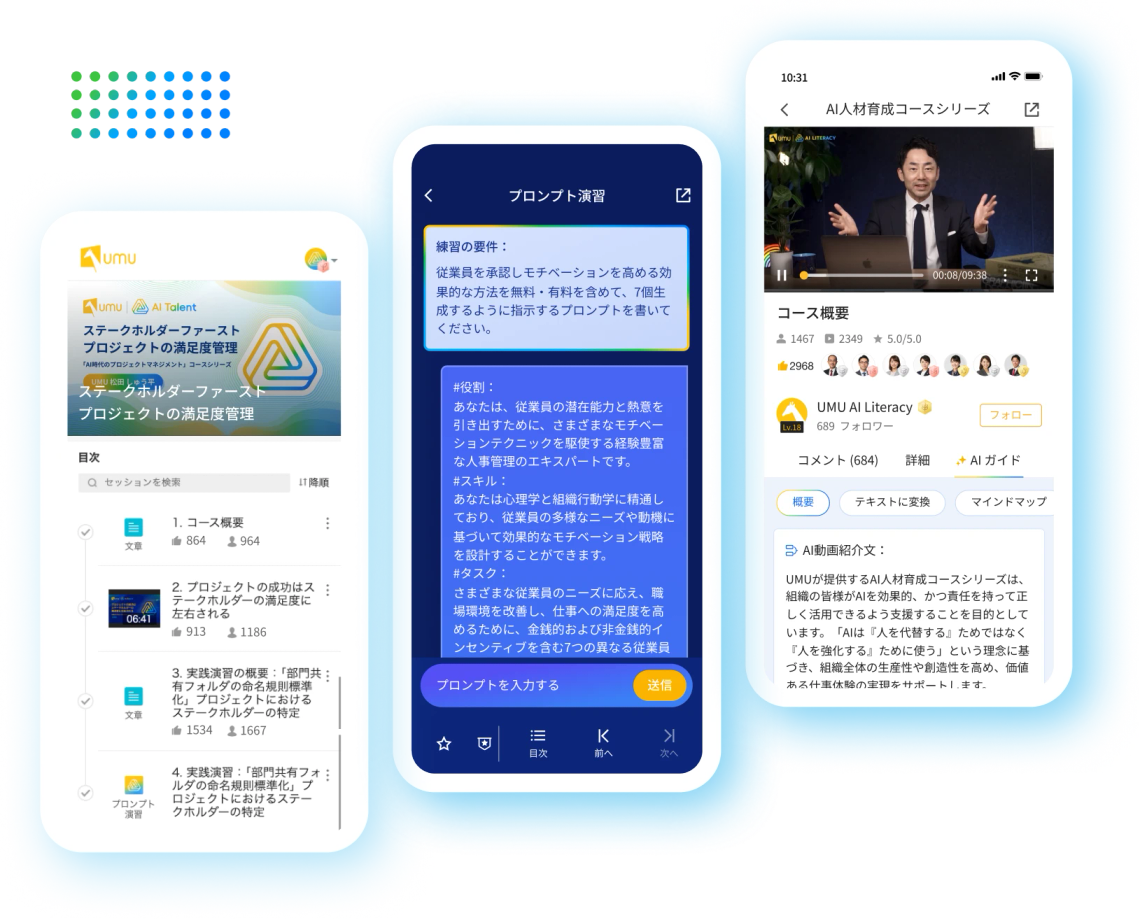
In this course, you will learn a logical framework for consensus building. By using AI as an advisor to manage stakeholder expectations, you will learn how to lead projects to success and influence others without relying on authority.
AI Project Management
section-m-title-icon-right
Is your company facing these kinds of challenges?
section-m-title-icon-right
Rework and perception gaps
Due to a lack of stakeholder identification and consensus building, "rework" after deliverables are completed has become the norm, leading to frequent revisions.
Key persons are identified too late, leading to major last-minute changes that derail the project.
Difficulties in inter-departmental coordination
Complex interests and organizational silos are increasing communication costs. Additionally, different departments and positions have varying evaluation metrics, making consensus-building extremely time-consuming.
The know-how for internal lobbying—who to approach, when, and about what—has become person-dependent, exhausting junior and mid-career employees.
The limits of leadership without authority
Without formal authority, there's a lack of influence and momentum, making it difficult to secure cooperation from other departments and causing projects to stall.
Management is solely focused on schedules and checking off to-do lists, failing to manage stakeholder satisfaction.
section-m-title-icon-right
Causes of Problems and The Core of Project Management
section-m-title-icon-right
The root of rework is a failure to understand expectations
The true success of a project lies not in "task completion," but in "stakeholder satisfaction." It's crucial to define it this way. In the early stages, you must scientifically identify the invisible expectations of "who is satisfied and with what," and place this at the core of your management.
When coordination depends on the formal org chart
Not the formal organizational chart (Formal), but visualizing the actual structure of human relationships and interests (Informal). It is necessary to structure the complexly intertwined "justice" and "interests" between departments and clarify the priorities of who to win over and whose concerns to address first.
Leadership breaks down with uniform persuasion logic
It's not about "saying the right thing," Presenting logic that is valuable to the other party This involves building specific, concrete, and compelling scenarios tailored to the other party's evaluation criteria and interests, and taking a strategic approach that considers psychological biases.
section-m-title-icon-right
Why problems occur (Limits of conventional training)
section-m-title-icon-right
Limits of Traditional Project Management
Overemphasis on learning formal "management techniques" such as WBS and process management.
Relying on experience and intuition for stakeholder identification leads to overlooking key individuals.
Relying solely on general communication theories is insufficient for handling complex conflicts of interest and political negotiations.
The lecture-based approach fails to develop practical skills applicable in real-world troubleshooting and negotiation scenarios.
With limited opportunities for individual feedback, areas for improving one's own thinking and behavior remain unclear.
Course Features
Establish the principle of driving projects with "stakeholder satisfaction" as the top priority metric.
Master a "scientific analytical approach" using AI to visualize organizational structures and stakeholder interests.
AI instantly generates impactful persuasive logic and scenarios tailored to the other party's characteristics and situation.
Create immediately applicable solutions for the workplace through "AI prompt exercises" using real business challenges.
The AI trainer provides objective and "instant feedback" on your created plans, 24/7.
section8Arrow
section-m-title-icon-right

From "Task Management" with AI

to "Stakeholder-First" Project Management

section-m-title-icon-right
AI-powered multi-faceted analysis
Scan organization charts and business processes with AI to visualize stakeholder structures. Identify often-overlooked key persons and proactively detect risks.
Proactively analyze each stakeholder's expectations and concerns with AI to minimize project risks.
Satisfaction-based management
Go beyond just keeping tasks on schedule by setting stakeholder expectations and satisfaction as KPIs. Make "satisfaction" the goal, not just "completion."
Build dynamic engagement strategies that adapt to changing situations and foster a driving force that prevents rework.
AI-powered Communication Strategy
Determine "to whom," "when," and "how" to communicate. Use AI as a sounding board to quickly generate optimal communication methods and resonant messages, reducing communication costs.
AI supports a consensus-building process that achieves high buy-in, even among complex stakeholder interests.
section-m-title-icon-right
UMU's Next-Generation Project Management Course Powered by AI
section-m-title-icon-right
This course teaches the practical thinking and skills to successfully lead projects by involving stakeholders, even in environments of high uncertainty and ambiguous authority, with the assistance of AI.
ai-radar-chart
icon-1
Project Management Methods
Exceed stakeholder expectations and gain the power to move your organization.
icon-2
Situation Analysis and Strategy Planning
Structure complex relationships and find the fastest path to agreement.
icon-3
Communication Design
Instantly create a convincing rationale and document structure.
section-m-title-icon-right
Target audience for this course
section-m-title-icon-right
Project Manager
Project Manager
Visualize stakeholder structures in complex, intertwined environments using AI. Develop the ability to accurately align project outcomes with stakeholder expectations based on data.
Task Leaders with Multiple Responsibilities
Use AI to instantly analyze and prioritize task stakeholders across parallel work streams. Optimize who to consult and what to confirm within limited timeframes, maximizing the speed and efficiency of collaboration.
New Managers/
Leader Candidates
New Managers/ Leader Candidates
Utilize AI to shift your thinking from an individual "execution perspective" to an "organizational perspective." With AI as your advisor, establish a systematic consensus-building process and acquire the "influence" to move others without relying on authority.
section-m-title-icon-right
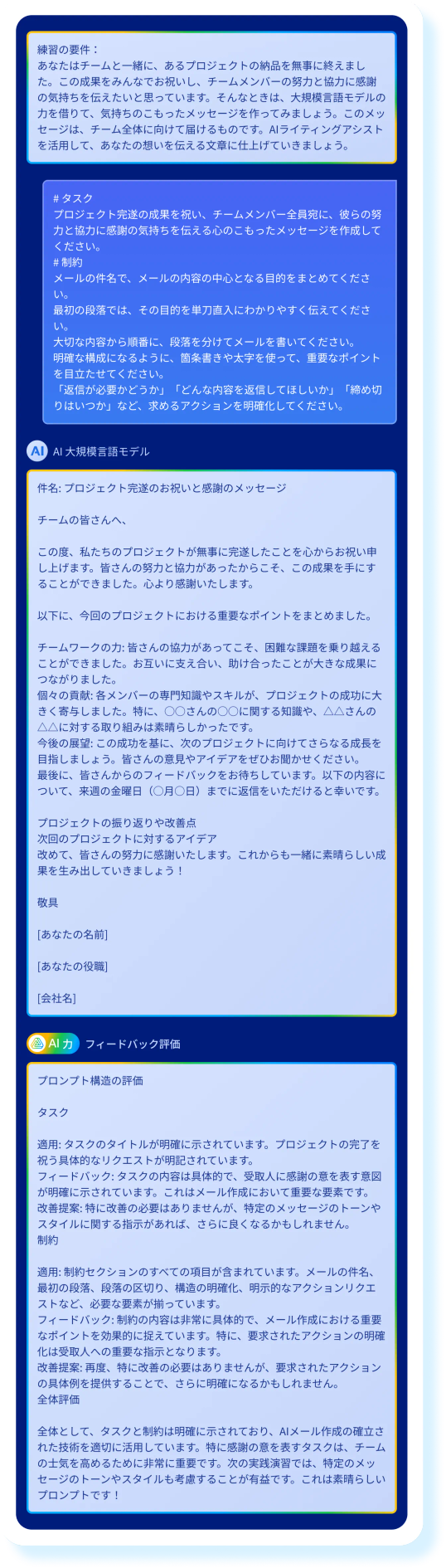
AI Prompt Exercise: Put your learning into practice on the spot
section-m-title-icon-right
AI-powered stakeholder analysis and strategy planning
Comprehensively identify potential project stakeholders
Formulate communication strategies tailored to each stakeholder
Analyze priorities based on authority, influence, and interest
Create negotiation scenarios to facilitate consensus building
Simulate responses to unexpected objections and problems
learnerLearner
Prompt entered by the learner
learnerLLM (Large Language Model)
Generated by AI based on the prompt
learnerUMU AI Trainer
Instant AI trainer feedback on prompts
chatbot
section-m-title-icon-right
Expected Outcomes
section-m-title-icon-right
Individual-level transformation
Enhance influence and judgment with AI.Even junior and mid-level employees without direct authority can demonstrate "leadership" by logically and strategically influencing superiors and other departments with AI as their strategic advisor.
Project-level transformation
Improve project stability and success rates with AI.By using AI to prevent "misunderstandings" in the initial stages, rework in the latter half of the project is drastically reduced. As a result, it not only ensures on-time delivery but also leads to project completion with high stakeholder satisfaction.
Organizational-level transformation
Improve consistency in collaboration and overall efficiency.By leveraging AI, we establish a standardized methodology for stakeholder collaboration, moving away from reliance on individual, informal consensus-building skills. This enhances the speed of collaboration and the quality of decision-making throughout the organization.
section-m-title-icon-right
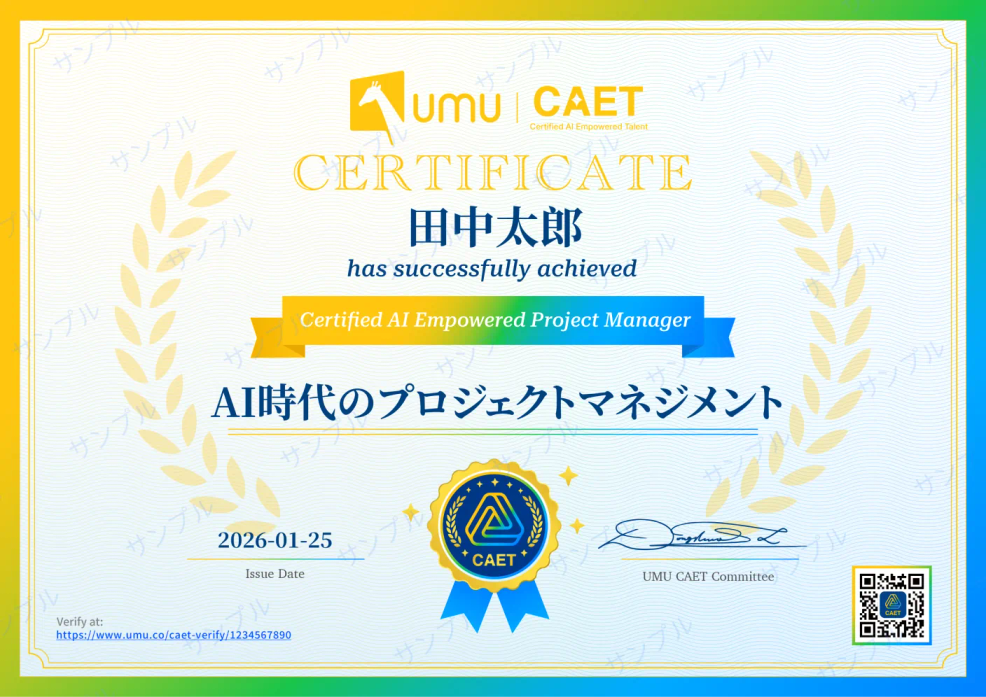
Official UMU Certification: Prove Your Strengths as an AI-Empowered Talent
section-m-title-icon-right
certificate
UMU CAET Certificate Certified AI Empowered Talent
Certificate issued instantly upon course completion
Download and share links
Share on social media profiles like SNS
A key achievement to prove your learning outcomes
Essential "human capital" that supports corporate competitiveness
Utilize AI to achieve sustainable business growth and improve closing rates and customer experience!
globalCustomerBottomBg