




Developing Next-Generation "Strategic HR" with AI
Through this course, HR professionals will master AI, enabling decision-making based on the global standard (SHRM) framework. This process eliminates individual skill gaps and leads to "AI Adoption," dramatically improving the entire organization's productivity and creativity.

Is your company facing these kinds of challenges?
The "Dissonance" of AI Implementation
(Tools exist, but adoption is lacking)
Phenomenon: Although AI tools have been introduced company-wide, their use is limited to a few "individuals" and does not contribute to improving the organization's overall productivity.
The Core Issue: "AI Implementation" is complete, but it has not led to the "AI Adoption" that drives business results.
Risk of the HR function becoming obsolete (Disconnected from business needs)
Symptom: As business departments independently adopt AI, HR fails to keep up and is no longer consulted as a strategic partner.
Root Cause: HR is focused solely on maintaining traditional operations and is failing to manage and lead the redefinition of organizational structure and governance (e.g., addressing shadow AI) necessitated by AI.
Individual "skill gaps" and "invisible obsolescence"
Symptom: The productivity gap between employees who are proficient with AI and those who are not is widening, yet the organization lacks objective guidelines for training and evaluation.
Essence: Clinging to experience-based work execution, failing to recognize the "productivity gap" with AI-native talent, leading to a progressive "invisible obsolescence" that diminishes market value.
Why isn't AI utilization translating into business outcomes?
Confusion between "AI Experience" and
"AI literacy"
Misconception: The assumption that "AI skills will naturally improve with frequent use."
Truth: Mere high frequency of use (AI fluency) only reinforces inefficient practices and increases unnecessary costs. True "AI literacy" is the ability to critically evaluate AI output and responsibly convert results into business value, and it can only be acquired through intentional learning.
Bias towards an "internal perspective" and
a lack of market awareness
Symptom: Bound by existing internal rules and customs, failing to integrate changes in the external environment into HR strategy.
The Core Issue: An "internal perspective" that only looks at the company's current situation cannot anticipate market and competitor changes driven by AI. What's needed now is the analytical capability of an "outside-in (external perspective)" approach, which derives strategy from external environmental trends. Advanced environmental scanning powered by AI is indispensable.
HR is failing to become a "leader of change"
Current Situation: Excessive regulations driven by compliance concerns, and a disconnect with frontline operations because implementation is left entirely to the IT department.
The Ideal State: HR should be the one to design a "new organizational culture" and "ethical guidelines (governance)" where AI and humans co-create. Based on human-centric principles, HR must take the leading role in driving AI transformation.
The Key Difference Between Conventional Training and This Course
Conventional AI Training / Tool Workshops
❌
Focus on tool operation: Training is limited to explaining how to write prompts and tool features, leaving practical application up to the learners.
❌
Limited to individual skills: The main focus is on individual time-saving techniques, with no ripple effect on overall organizational productivity or culture building.
❌
One-way lectures: Focuses on video viewing and classroom learning. It's unclear how to specifically apply this knowledge to complex, real-world business challenges.
UMU "HR Empowerment" Course
✅
Competency-focused: Based on the SHRM (global standard) framework, it enhances core HR competencies with AI, supporting the evolution into a strategic partner.
✅
Directly linked to organizational transformation: With the goal of "AI Adoption," we cover everything from fostering an organizational culture to policy development.
✅
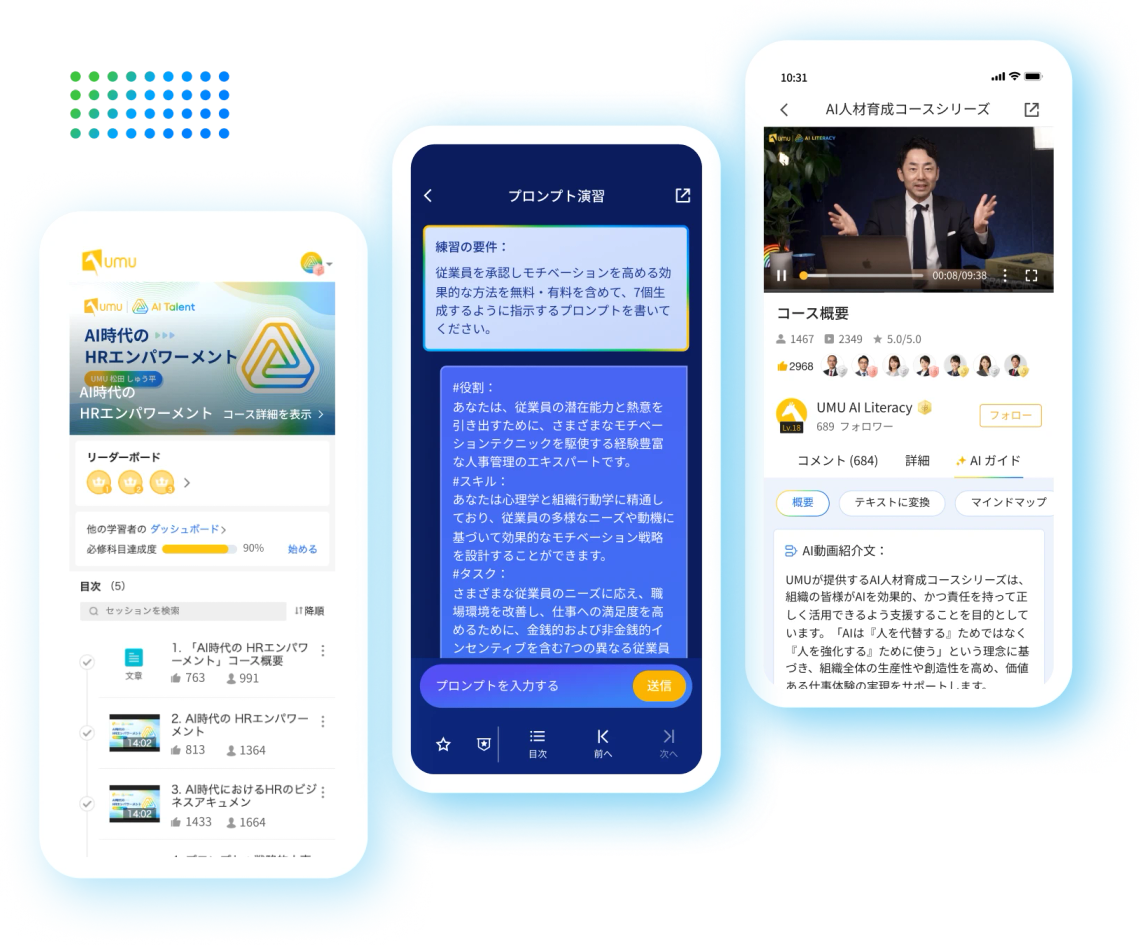
Interactive AI Exercises: UMU's unique AI trainer provides instant feedback on individual prompts, ensuring you master practical, job-ready skills.
Based on the global standard framework "SHRM"
4 Core Competencies
Business Acumen
(Business Sense)
AI-Powered Augmentation
Real-time PEST (Political, Economic, Social, Technological) analysis using LLM's Deep Search feature.
Generate strategic questions to translate external environmental changes into internal talent strategy.
Expected Outcomes
Transition from "reactive" HR to "Strategic HR" that makes data-driven recommendations to management.
Leadership and
Navigation
AI-Powered Augmentation
Building a 5-element framework (Culture, Leadership, Knowledge, Policy, Tools) to transition from "AI implementation" to "AI adoption."
Establishing governance based on "The user is responsible" principle.
Expected Outcomes
Transform individual tacit knowledge into "organizational standard capabilities." Establish AI utilization as a culture and build a sustainable competitive advantage.
Communication and Relationship Management
AI-Powered Augmentation
Optimize the tone and manner of asynchronous communication (e.g., email) and predict/avoid risks.
Simulation of synchronous communication (e.g., interviews) through AI role-playing.
Expected Outcomes
Minimize communication costs and improve organizational resilience in crisis management.
Ethical Practice
AI-Powered Augmentation
Setting boundaries for AI use in "high-stakes" areas such as hiring, evaluation, and promotion.
Developing protocols that comply with data privacy and compliance.
Expected Outcomes
Avoiding legal risks and maintaining employee engagement (trust in the organization).

AI Prompt Exercise: Apply What You've Learned
Solving HR Challenges with AI
Utilize AI to comprehensively analyze the external environment (PEST)
Utilize AI to formulate "strategic recommendations" for management
Utilize AI to create a "roadmap" for company-wide transformation
Utilize AI to simulate "feedback" that generates buy-in
Utilize AI to assess "ethical risks" in HR initiatives
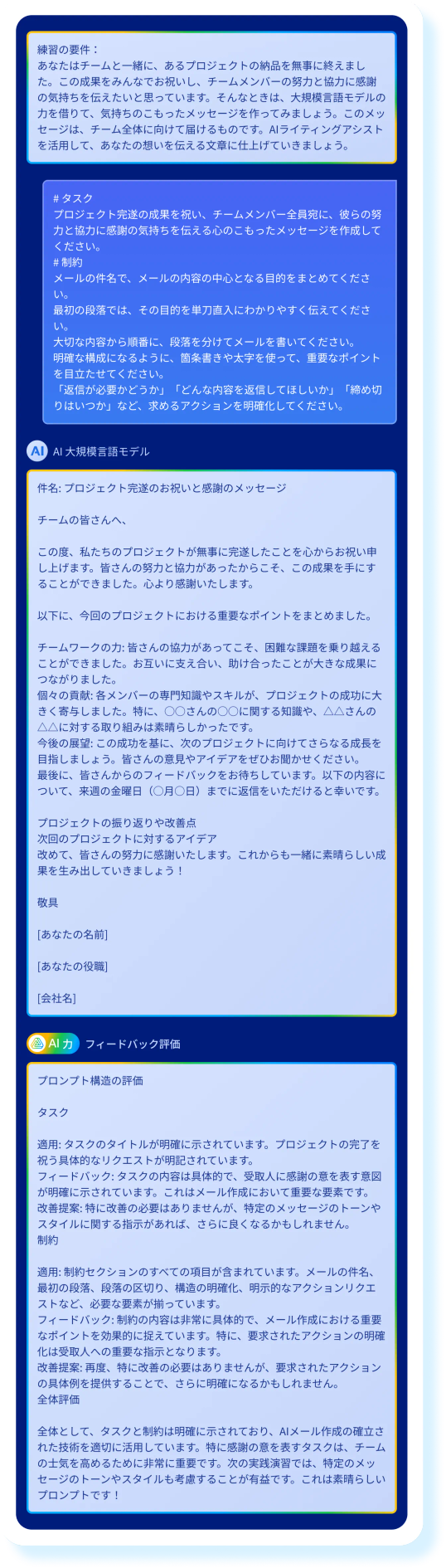
Prompt entered by the learner
Generated by AI based on the prompt
Instant AI trainer feedback on prompts

3 Transformations This Course Delivers
Individual Transformation:
Enhancing Your Professional Value
From using AI to directing it. Free yourself from administrative tasks and transition to strategic work that leverages your HR expertise.
Team Transformation:
Establishing Your Role as a Business Partner
Become an HR Business Partner (HRBP) who communicates with management and business units in a common language (business metrics and strategy) and supports data-driven decision-making.
Organizational-level transformation:
Gaining a sustainable competitive advantage
Achieving "AI Adoption" enhances the entire organization's productivity and creativity, fostering a corporate culture that flexibly adapts to change and drives sustainable growth.
Target audience for this course
HR Professionals
For those who want to maximize their unique professional and career value, starting with leveraging AI for operational efficiency.
HRBP/Manager
For those who want to lead the use of AI in the field, maximize the value provided to business departments (ROI), and drive organizational transformation.
Executives/CHRO
For those who want to lead the enhancement of organizational capabilities and establish governance by leveraging AI from a human capital management perspective.
UMU Official Certification: Prove Your Strengths as an AI Professional

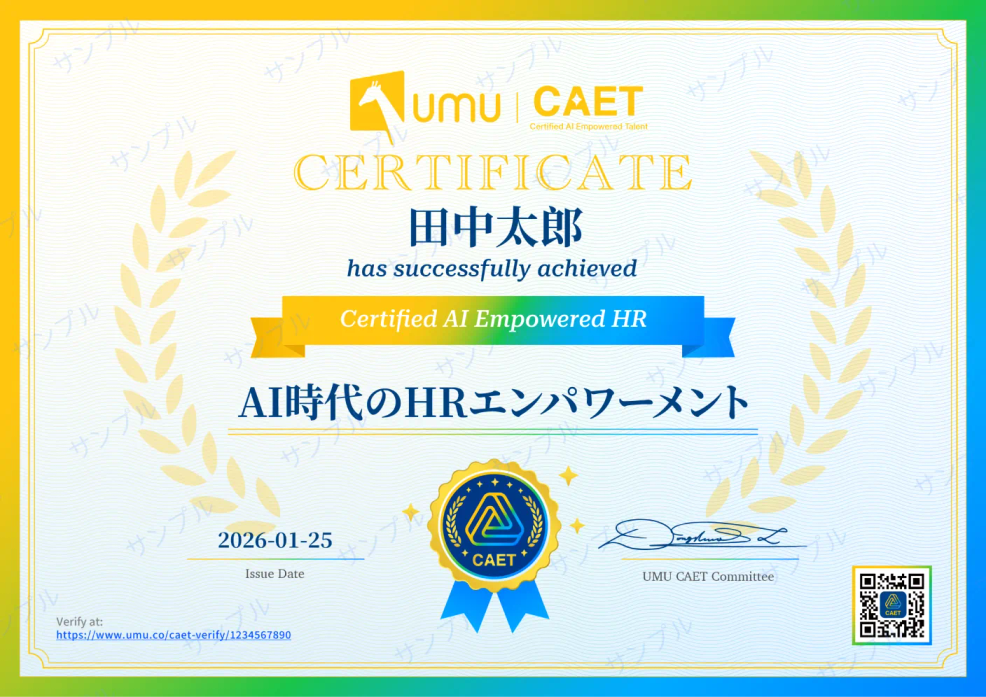
UMU CAET Certificate
Certified AI Empowered Talent
Certificate issued instantly upon course completion
Download and share links
Share on social media profiles like SNS
A key achievement to prove your learning outcomes
Essential "human capital" that supports corporate competitiveness
Leverage AI to compensate for skill gaps and maximize performance